
The numbers are a mirror.
I spent the last few days inside Canada's public procurement data. Every award published on CanadaBuys this year, every supplier, every dollar I could trace. I went in looking for patterns. I came out with something closer to a portrait of who we are right now, and who we could become.
The numbers first. Then let's talk.
Key findings
The figures cover federal contract awards dated January 1 to July 20, 2026, as published on CanadaBuys. Award notices publish on a delay, so the most recent weeks are still filling in.
- $5.63 billion awarded across 2,391 funded contracts to 1,653 companies. Another 840 published awards carried no dollar value, mostly pre-qualifications and standing offer listings, and every dollar figure in this piece excludes them
- 200 companies, the top 12 percent of funded winners, took 85.4 percent of the money
- A small group of winners are not businesses at all. 56 universities, colleges and public institutions took 0.8 percent of the dollars. They stay in the totals but sit outside the small, medium and enterprise split
- The remaining 1,453 companies, the vast majority of them small businesses, shared the other 14.6 percent of the dollars
- 768 companies won their first federal contract ever this year, ahead of the 749 that did over the same stretch of 2025. The door is opening wider.
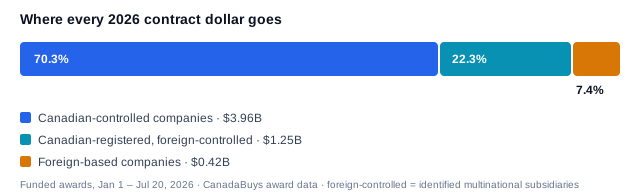
- Roughly 30 percent of every contract dollar went to foreign-based companies or Canadian-registered companies controlled by foreign parents
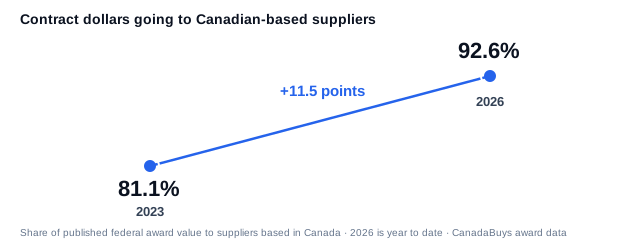
- Canadian-based suppliers took 92.6 percent of award dollars, up from 81.1 percent in 2023. An eleven point climb in three years
- Roughly 20 of the top 200 winners, or their parent companies, announced layoffs this year, and at least four of them cut Canadian jobs
- Bell Canada was awarded about $215 million in published federal contract value in the same six months its parent company BCE cut roughly 750 Canadian roles across its units
Now the part the numbers can't say on their own.
First, credit where it belongs
This data exists because our government publishes it. CanadaBuys is a platform, and the departments, provinces and municipalities that buy through their own procurement cycles are doing exactly what they should: putting the record in public view. Most countries don't. I could only write this piece because Canada chose transparency, and that matters.
And the direction is right. More than nine in ten award dollars went to companies registered here. There is a real, visible effort to bring projects home. Seven hundred and sixty eight brand new companies got their first win this year, ahead of the 749 that managed it over the same stretch of last year, and most of them were small. That's not a broken system. That's a massive shift in the right direction.
The improvement is measurable, not rhetorical. In 2023, Canadian-based suppliers took 81.1 percent of federal award dollars. In 2024 it was 86.7. Last year, 92.6, and this year is holding right at that level. That is an eleven point repatriation of contract dollars in three years, sitting right there in the public record.
But improvement lives in the details, and the details are where we become better as a country.
The details worth looking at
I understand why certain corporations win the biggest contracts. When you need satellites, munitions, or a national telecom backbone, there are sometimes only one or two companies in Canada who can deliver. Nobody should apologize for that.
The question is everything below that tier. Some requirements are written in a way that only very large companies, or the incumbents who won last time, can even qualify. Insurance thresholds, revenue minimums, certifications that take years and money a ten-person firm doesn't have.
When 200 companies take 85 cents of every dollar, and the sole-source lane flows overwhelmingly to the largest players, we should at least ask whether the requirements are protecting quality or just protecting position. That deserves closer looking into. Not blame. Attention.
To be fair, most of that concentration is a handful of national projects. Just 83 contracts of ten million dollars or more carry 69 cents of every dollar awarded this year, and once you set those aside, the remaining market spreads far more widely.
The second detail is ownership. On paper our procurement looks almost entirely Canadian. Follow the ownership and nearly one of every three dollars goes to a company whose ultimate owners sit outside Canada.
That's not a scandal, it's a signal
Let me be fair about what that means. Much of that money still lands here, in Canadian wages, Canadian suppliers and Canadian taxes, and part of the profit leaves the country. How much leaves and how much stays is something the public data simply does not tell us, and that gap itself is worth fixing. Canadian-controlled companies need to become more competitive, and we need to help them get there, because a contract won by a fully Canadian company keeps the whole dollar circulating here, profits included, not just a share of it.
The data we don't collect
One more detail, and it's about what the record cannot show. Canada tracks Indigenous-owned suppliers, with a 5 percent procurement target that was met this year. That's proof we can measure ownership when we decide to. But no procurement database has a field for any other inclusive ownership. Not women-owned, not Black-owned, not minority-owned.
To test what that blind spot hides, I cross-referenced every public directory of Black-owned businesses I could find against the full disclosed contract record, about $1.17 trillion going back more than a decade. I could verify roughly $150,000. That's about 0.00001 percent. It's a floor, not a census, and that's exactly the problem. Nobody can compute the real number, because it was never tracked. What gets measured gets improved, and the Indigenous target proves it. Extending that measurement to other underrepresented owners would cost almost nothing, and it would tell us who the door is really opening for.
The precedent that worries me
Here is where I stop being gentle, because this part isn't about government at all. It's about choices.
Profitable giants cut hundreds of roles
Bell Canada was awarded about $215 million in federal contracts this year. Its parent company BCE is profitable, reporting $667 million in net earnings in the first quarter alone, and BCE cut roughly 750 Canadian roles across its units in the same window, about 690 announced in June plus a smaller Bell Media round in February. And this is not a one-off. Those cuts came on top of roughly 690 roles eliminated last November and 4,800 announced in 2024.
To be fair, Bell attributes the cuts to its fibre migration and a broader push for operating efficiencies, not to any one technology, and I can only go by what is public. But here is the tension I cannot square. The same company is building AI data centres, a program it calls Bell AI Fabric, starting with six sites in British Columbia, and BCE is telling investors it expects about two billion dollars a year in AI revenue by 2028. Bell's newest data centre announcement promises sixteen hundred jobs. The fine print says eight hundred are temporary construction roles, seven hundred and fifty are projected economic spin-offs, and the permanent positions number about eighty.
Build the future with the people you have
Look, we all use AI. I build with it every day. And yes, new data centres create real jobs in construction and operations. But walk through the logic with me. A worker loses their job to an efficiency drive while their employer pours money into infrastructure it promotes as the future of job creation. The person let go is supposed to applaud the new roles rising next door.
Bell is not alone. Rogers offered voluntary buyouts to about ten thousand employees, roughly half its non-sports workforce, and closed six radio stations while its subsidiary held federal work.
Cisco announced record quarterly revenue, cut close to four thousand people globally including Canadians, and its Canadian arm won federal work this year too. CAE cut 280 jobs, most of them in Montreal.
IBM keeps running quiet rounds of cuts while holding government contracts. Even the Big Four are shrinking, with KPMG's UK firm cutting nearly six hundred roles this spring and Deloitte trimming repeatedly across its American and British arms. Boeing, GSK, Accenture, Salesforce and Broadcom all reduced headcount somewhere in the world this year while their subsidiaries were being awarded Canadian public money.
Money coming through the front door, pink slips going out the back
I want to be careful and fair here. I don't know the full story inside these companies. There may be pressures I can't see from the outside. But I can tell you how it looks from where most people stand: public money going in the front door while pink slips go out the back. It sets a dangerous precedent, and it does not represent Canada, and it does not represent the new initiatives this government is taking to protect and create jobs. When we see companies hurting society, we need to speak up. This is me speaking up.
Because here is the contrast, from the same dataset. MDA, headquartered in Brampton, won the largest award of the year and just completed a Montreal expansion that doubled its satellite manufacturing floor space, and it is still hiring. Nouveau Monde Graphite broke ground in Matawinie. Sanofi opened a new vaccine facility at its Toronto campus in 2024 and is investing over two billion dollars in Canada by 2028, under a commitment to create and maintain more than twelve hundred skilled jobs. Ledcor has hundreds of roles open right now. Even Michelin, while weighing voluntary job cuts in France, completed a three hundred million dollar upgrade of its Nova Scotia plants announced in 2023 and added roughly seventy jobs in Bridgewater. Dozens of small winners, from Ottawa IT firms to a marine supplier in Campbell River, are visibly hiring. Growth and public money can point in the same direction. Some companies prove it every day.
Two paths converge, only one saves human workers
We are living through a moment where people are genuinely worried, and I refuse to pretend they're wrong to be.
There are two paths in front of every large organization right now. The first is to use AI to cut jobs, book the savings, and call it efficiency. It's a quick win, and it quietly sends the bill to society. The second path is harder and better: reskill, retrain, redeploy. Take the person whose task was automated and move them up to the work the machine can't do, the judgment, the relationships, the craft.
I have skin in this game, so let me be transparent about where I stand. My company builds decision intelligence for operations, and we made one design choice on day one: the AI drafts, the human decides. Every consequential call in our platform routes to a person, with the evidence attached. Our customers do not end up with fewer people. They end up with sharper ones, because the hours that used to go into hunting for information now go into judgment. So when I say the second path is real, it is not theory to me. I watch it work.
A few weeks ago in my interview with News Nation I talked about IKEA, because it's the cleanest example I know. When its AI assistant took over nearly half of customer service queries, IKEA's operator Ingka didn't lay off the 8,500 call centre workers affected. It retrained them as interior design advisers, and the remote design business they now staff brings in about 1.4 billion dollars a year by the company's own account. The people kept their livelihoods, the company found a business it didn't know it had, and the customers got something better. Nobody lost.
This subject is dear to me. I build AI for a living, and I genuinely believe research investment in AI can bring down the cost of living itself. Autonomous agriculture that makes food cheaper. Automated logistics that make goods cheaper. AI in healthcare administration so more of every health dollar reaches care instead of paperwork. Cheaper energy through smarter grids. And if production genuinely gets cheaper, we get a choice previous generations never had: we can reduce working hours without reducing lives. Done right, abundance buys back time.
But we have to stick through the uncertain years in between, and we have to redesign the on-ramps. Honestly, we need to ask hard questions about education too. If intelligence is becoming abundant, is a four-year degree still the right default for every career? I'd rather see more research degrees for the people pushing the frontier, and fast, practical micro-credentials for everyone learning to manage agentic workflows, because that is where the jobs are heading. The beautiful path ahead is real. It just isn't automatic.
That's the fork. The IKEA path or the layoff path. More wealth, better distributed, or AI doing what AI does best, which is accelerate whatever we point it at. Right now, pointed carelessly, it will accelerate the gap. The top 20 percent already hold two thirds of the wealth in this country. We can create more wealth and share it more widely, or we can automate our way into a smaller and smaller room.
Where I land
I love this country's instincts. Publish the data. Bring the projects home. Open the door to first-time winners, 768 of them this year and counting. Now let's mind the details: widen the requirements so newer companies can compete, strengthen Canadian-controlled firms so the whole dollar stays home, and yes, look harder at whether public contracts should keep flowing, unquestioned, to companies that treat Canadian jobs as a cost line while banking Canadian revenue.
Tommy Douglas said it better than I ever will: “Courage, my friends; 'tis not too late to build a better world.”
I read about AI for a living and I write about where I think it's taking us, the honest good and the honest risk. If these questions matter to you too, follow along at my new Substack, The Coordination Age. Come argue with me. That's how the details get better.
Mohamed Yousuf is the co-founder and CEO of MAIA Intelligence, a Canadian AI company. All procurement figures are drawn from public CanadaBuys award data covering awards dated January 1 to July 20, 2026, and Statistics Canada.
Sources and references
Procurement and economic data
- CanadaBuys open procurement data
- CanadaBuys award notices dataset, Open Government
- Proactive disclosure of federal contracts over $10,000
- Corporations Canada federal corporations open data
- Statistics Canada, Labour Force Survey (Table 14-10-0287-01)
- Statistics Canada, wealth distribution, The Daily, April 13, 2026
Layoff and workforce reporting, 2026
- Bell/BCE job cuts — CBC News, June 2026
- Bell/BCE job cuts — CP24, June 15, 2026
- Bell/BCE layoff history (Nov 2025, 2024) — Samfiru Tumarkin LLP
- BCE Q1 2026 results — PR Newswire
- Bell AI Fabric — Bell (official)
- Bell AI Fabric — BetaKit
- Bell AI Fabric 500MW BC supercluster — Data Center Dynamics
- Bell Saskatchewan data centre job figures — Bell announcement
- Bell $1.7B Saskatchewan data centre — BNN Bloomberg, March 2026
- Rogers buyouts — CBC News, April 2026
- Rogers buyouts — Bloomberg, April 27, 2026
- Rogers customer service cuts — CBC Go Public, July 2026
- Cisco — TechCrunch, May 2026
- Cisco Canadian impact — Samfiru Tumarkin LLP
- CAE — Global News, April 2026
- CAE — The Globe and Mail
- IBM — TechCrunch running list of 2026 AI-cited layoffs
- Broadcom and VMware — Kore1 WARN summary
- Salesforce — Quartz, February 2026
- Accenture — Gulf News
- KPMG UK — Bloomberg, March 2026
- Deloitte — Going Concern, January 2026
- GSK — Fierce Biotech, February 2026
- Boeing — AeroTime, February 2026
- General Dynamics (GDIT) — WARN Tracker
- Shell — London Daily, July 2026
- Bosch — TVP World, February 2026
- Michelin France voluntary cuts — Tyrepress, May 2026
Inclusive ownership data gap
- Indigenous procurement target (5% minimum) — Indigenous Services Canada
- Black-owned businesses in Canada, 2020 — Statistics Canada
- Black business owners in Canada — Statistics Canada study
- PSPC Black Businesses Procurement Pilot (2021) — briefing materials
- CanadaBuys RFI summary, Black-owned or led businesses (2021)
- BC Black-business certification, 'almost zero' contracts finding — CBC
- PSPC supplier diversity story (Mante Molepo Consulting)
Growth and investment reporting
- MDA Space Montreal expansion — BetaKit, May 2026
- Sanofi Toronto investments — Sanofi Canada, May 2026
- Sanofi jobs agreement — ISED, 2021
- Michelin $300M Nova Scotia investment — Michelin, 2023
- Michelin Nova Scotia plants — CBC, 2025
- Nouveau Monde Graphite Matawinie — Mining.com
- IKEA/Ingka retraining — CIO
- IKEA/Ingka retraining — PYMNTS
Layoff findings reflect public reporting between January 1 and July 22, 2026 for the 200 largest contract recipients and their corporate parents. Companies described as having no reports may have made workforce changes that were not publicly disclosed.